
Annapurna Devi
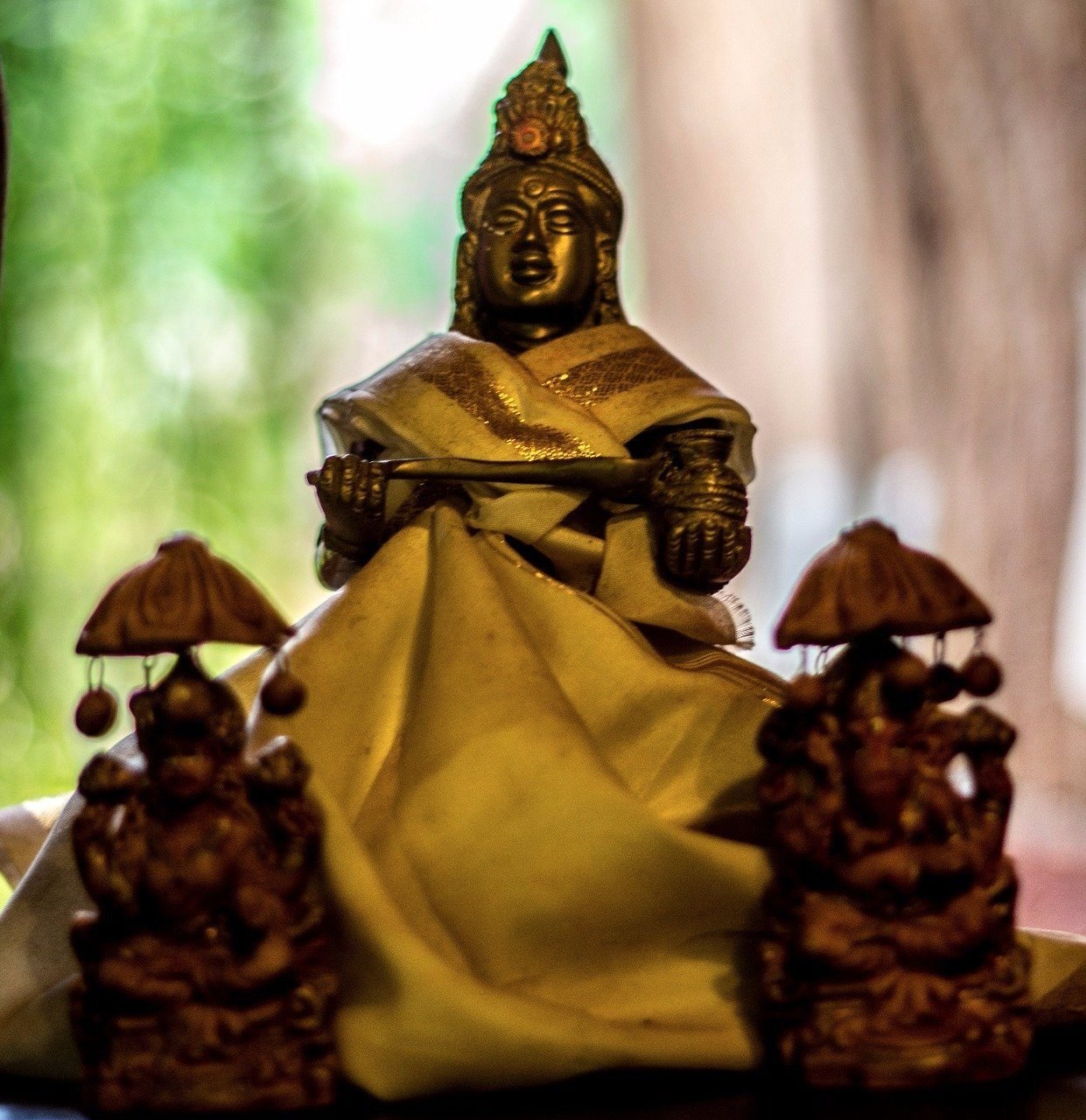
Food occupies a very special place in the Indian spiritual traditions. It is not regarded merely as something that satisfies hunger or gives pleasure to the senses. Annam…
Read article
The Meaning and Spiritual Significance of a Traditional Indian Greeting
Namaste, and its common variant Namaskar, is one of the most familiar forms of greeting in India. It is used when meeting someone, whether a friend, an acquaintance or a stranger, and can also be used when taking leave.
For many people today, Namaste may simply be a polite Indian greeting. But traditionally, the gesture carries a meaning that goes beyond courtesy.
It is not merely a word or a physical gesture. It can also be an expression of respect, humility and recognition of something deeper within the person standing before us.
The Sanskrit expression is traditionally understood as namah + te, meaning “salutations to you” or “I bow to you”.
The word namah carries the sense of bowing, paying homage or offering respect, while te means “to you”.
There is also a spiritual interpretation of namah as na ma, “not mine”. In this understanding, the gesture can be seen as a reminder to soften the sense of individual ego and possession.
This is one of the reasons Namaste has such a beautiful place within Indian spiritual culture.
It is possible to understand the gesture simply as “I bow to you”, but at a deeper level it can also be understood as:
This does not necessarily refer to a particular religious belief. It points towards the Yogic understanding that beneath our individual personalities, identities and differences there is a deeper consciousness that is common to all.
The gesture itself is simple.
Bring the two palms together in front of the chest, with the fingers pointing upwards. The hands are held gently rather than pressed together forcefully. The head may be bowed slightly while saying the word Namaste.
The position of the hands before the heart is significant in traditional practice. It brings the gesture into the space associated with the heart and creates a moment of physical and mental pause.
There is no need for an elaborate movement. A simple Namaste, offered with genuine awareness, is enough.
Namaste can certainly be a casual greeting, a formal courtesy or simply a cultural convention. But the traditional understanding allows us to see something more in the gesture.
The real meeting between two people is not merely the meeting of two bodies. It is the meeting of minds, attitudes and hearts.
When we greet another person with Namaste, the folded palms can be understood as a gesture of bringing ourselves together in mutual respect. The slight bow of the head expresses humility and goodwill.
In this sense, Namaste is not about making ourselves smaller than another person. It is about meeting another human being without unnecessary arrogance or separation.
We acknowledge the other person.
We offer respect.
We recognise that there is something worthy of honour beyond the surface personality.
The two hands coming together can also be understood symbolically.
The hands are separate, yet they meet in the centre. In a similar way, two individuals may appear completely separate, with different histories, personalities, beliefs and circumstances, while sharing the same fundamental experience of being alive.
The gesture creates a moment of meeting.
In Yoga, the body and mind are not treated as completely separate from our deeper experience of consciousness. Simple physical gestures can therefore carry an inner meaning when performed with awareness.
This is one reason why traditional Indian gestures often have several layers of meaning. What appears to be a simple social custom can also become a reminder of a deeper understanding.
There is an old poetic description of Namaste that captures this beautifully.
The poet describes two people meeting: their eyes meet, the mouth opens into a smile, they bow to one another, and the 72,000 nadis rejoice.
The reference to the 72,000 nadis belongs to the traditional Yogic understanding of the subtle body. Nadis are described as channels through which prana, the vital force, moves.
The number 72,000 is found in traditional Yogic literature and is generally understood within the symbolic and subtle framework of Yoga rather than as a straightforward anatomical description.
The poem is therefore not trying to describe a physical process that can be measured in the ordinary sense. It expresses something much more poetic: that a genuine meeting between two people can create harmony, openness and a sense of connection.
The deeper spiritual significance of Namaste lies in the recognition of oneness.
Yoga teaches that the individual experience of life can make us feel separate from everyone and everything around us. We identify ourselves through our name, body, nationality, profession, beliefs, relationships and personal history.
These identities are part of our everyday life, but Yoga asks us to look beyond them.
The gesture of Namaste can become a small reminder of this deeper teaching.
When we bring the palms together and bow the head, we can recognise the life force, consciousness or Divine presence within ourselves and acknowledge the same principle in the person before us.
In this understanding, the greeting is not simply:
It becomes something closer to:
For someone beginning Yoga, Namaste may initially seem like a familiar Indian gesture used at the beginning or end of a class.
Its deeper meaning becomes clearer as one studies the broader tradition.
Yoga is not only about asana. It includes an understanding of the mind, prana, consciousness, relationships and the way we live our daily lives.
A gesture such as Namaste can therefore become part of that wider awareness.
At SWAN, where traditional Hatha Yoga is practised alongside meditation, pranayama, Yoga Nidra and the study of Yoga philosophy, these seemingly simple aspects of Indian tradition are approached with the understanding that practice and daily life are not separate.
The way we sit, breathe, greet another person, eat, speak and work can all become opportunities for awareness.
Namaste is a very simple example.
The gesture takes only a moment, but the attitude behind it can stay with us much longer.
Perhaps the most beautiful thing about Namaste is that nothing elaborate is required.
Two hands come together. The head bows slightly. We acknowledge another person.
Yet within that simple gesture are ideas of respect, humility, connection and the recognition of something greater than the individual ego.
Whether we use Namaste as a traditional Indian greeting, as part of a Yoga practice or simply as a gesture of courtesy, it becomes more meaningful when we perform it with awareness.
The next time you say Namaste, perhaps pause for a moment.
Look at the person before you.
Bring the palms together.
Bow gently.
And remember that the greeting can be more than a word. It can be a small recognition of the shared consciousness that connects us all.
Article by Gyanmitra Saraswati.
Copyright SWAN Yoga Retreat, Assagao, Goa, India.
 Philosophy
Food occupies a very special place in the Indian spiritual traditions. It is not regarded merely as something that satisfies hunger or gives pleasure to the senses. Annam…
Read article Philosophy
Yoga, to me, is both quite simple and wonderfully elaborate. It can satisfy our never ending quest for an understanding of health, happiness and existence itself.
Read article Philosophy
Giving is very powerful. Give whatever you can, but you have to give. This is a universal principle, and whenever we interrupt that natural movement, there are consequences…
Read articleEverything written here is taught in person, in sequence, at the ashram in Assagao.