
Feeling Oneness with Spirit: The Quest for Samadhi
“Samadhi does not come upon anyone by accident. It takes dedication and effort.”Kaisa Kapanen
Read article
Predictive Indian Astrology, commonly known as Vedic Astrology or Jyotisha, is a traditional Indian system of studying the relationship between celestial movements and human experience. For centuries, Jyotisha has been used to understand patterns of time, individual tendencies, important periods of life and the circumstances that may arise during different stages of a person’s journey.
At the centre of predictive Indian astrology is the birth chart, or Janma Kundli, calculated from the date, time and place of birth. The chart is interpreted through the positions of the planets, the twelve houses, the zodiac signs, planetary relationships and various systems of timing. Among these, the Dasha system and planetary transits are particularly important in predictive astrology.
For someone approaching astrology for the first time, the birth chart can appear complicated. Yet the underlying idea is relatively simple. The chart provides a symbolic map of the heavens at the moment of birth, while the movement of the planets and the progression of planetary periods provide a framework for studying how different themes may become more prominent at different times.
Predictive Indian Astrology belongs to the wider tradition of Jyotisha, one of the classical knowledge systems associated with India. The word Jyotisha is traditionally associated with light and illumination, and the discipline has historically been concerned not only with interpreting planetary positions but also with understanding time and its cycles.
Unlike a general horoscope based only on a Sun sign, a Vedic astrology reading begins with the complete birth chart. The Ascendant, Moon, Sun and other planetary positions are considered together, along with the twelve houses and their lords. Different combinations are then interpreted according to the principles of Jyotisha.
The purpose of predictive astrology is not simply to make dramatic predictions about the future. A serious reading attempts to understand tendencies, circumstances, possibilities and periods of greater or lesser emphasis in a person's life. The quality of the interpretation depends greatly on the astrologer's understanding of the chart and the traditional principles being applied.
The Janma Kundli, or birth chart, is one of the fundamental tools of Vedic Astrology. It is calculated according to the precise time and geographical location of birth, because even relatively small differences in birth time can sometimes alter important elements of the chart.
The twelve houses of the Kundli represent different fields of human experience. Depending on the house and the planetary influences involved, these may include identity and personality, family and resources, communication, home and emotional foundations, creativity, health and service, relationships and partnerships, shared resources, higher learning, career, social networks and deeper forms of withdrawal or spiritual enquiry.
The planets occupying these houses, their zodiac signs, their relationships with other planets and the condition of the relevant house lords all contribute to the interpretation.
This is why a serious Vedic astrology reading cannot be reduced to a single statement such as, “You are a Leo,” or “Your Moon is in Taurus.” The complete chart provides a much richer picture.
In Jyotisha, the planets are traditionally understood as significant indicators of different dimensions of human experience. The Sun, Moon, Mars, Mercury, Jupiter, Venus and Saturn are the seven classical visible planetary bodies used in traditional astrology, while Rahu and Ketu, the lunar nodes, are also central to many systems of Vedic astrology.
Each planet is associated with particular qualities and areas of experience. The Sun is traditionally associated with vitality, identity, authority and individuality, while the Moon relates strongly to the mind, emotions and inner experience. Mars is associated with energy, courage and action, Mercury with communication and discrimination, Jupiter with knowledge and expansion, Venus with relationships and enjoyment, and Saturn with discipline, responsibility, limitation and perseverance.
Rahu and Ketu have a distinctive place in Indian astrology. As the ascending and descending lunar nodes, they are not physical planets, yet they are given considerable importance in the interpretation of the birth chart.
These meanings should not be understood in isolation. A planet's significance changes according to its house, sign, strength, associations and relationship with other elements of the chart.
One of the features that distinguishes predictive Indian astrology is the importance given to planetary periods, or Dashas.
A birth chart may indicate particular potentials or tendencies, but predictive astrology also asks an important question: When are these themes likely to become more prominent?
The Dasha system provides one traditional method of examining this question. The Vimshottari Dasha system is particularly widely used and divides the life into periods associated with different planets. These major planetary periods are further divided into sub periods, allowing an astrologer to examine the unfolding of different themes with greater detail.
Dashas are generally interpreted alongside planetary transits and the birth chart itself. A single planetary period does not automatically mean that a particular event must occur. Rather, the astrologer considers several factors together before forming an interpretation.
This is one reason predictive Indian astrology can become quite detailed when an astrologer is examining questions concerning career, relationships, relocation, education, major responsibilities or periods of significant personal change.
Alongside Dashas, planetary transits, known traditionally as Gochar, are another important part of predictive Vedic Astrology.
The planets are constantly moving through the zodiac, creating changing relationships with the positions found in an individual's birth chart. Some transits are relatively short, while others, particularly those involving Saturn and Jupiter, can influence a particular area of life for a much longer period.
An astrologer may therefore examine the birth chart, the current planetary transits and the relevant Dasha periods together. This creates a framework for understanding why certain periods may feel more active, demanding, expansive or inward looking than others.
Astrology traditionally works with patterns of time rather than treating life as a series of isolated events. The same transit can therefore have different significance for different people because each person's birth chart provides a different context.
People often approach a Vedic astrology consultation when they are going through a period of uncertainty or facing an important decision. Questions may concern career, business, relationships, marriage, relocation, education, finances or personal and spiritual development.
A birth chart can also be explored as a means of understanding one's tendencies and recurring patterns. In this sense, astrology can be used not only for prediction but also for reflection.
For example, someone may wish to understand why particular themes seem to repeat in their professional life, why certain periods have brought significant changes or why particular relationships have become important at particular stages of life. An astrological reading may offer a traditional framework through which these experiences can be examined.
It is important, however, to approach astrology responsibly. A birth chart should not be presented as a substitute for qualified medical, psychological, legal or financial advice. Nor should predictions be used to create unnecessary fear. Traditional astrology is most useful when it encourages awareness, reflection and responsible action rather than dependence.
One of the most interesting questions surrounding predictive astrology is whether the birth chart represents fixed destiny.
Different schools and practitioners approach this question in different ways. Traditional Indian thought does place considerable importance on karma and the patterns carried into one's present life, but this does not necessarily mean that every event is understood as completely predetermined.
The birth chart can instead be viewed as a map of tendencies and circumstances within a particular framework of time. How a person responds to those circumstances remains an important part of the human experience.
This distinction is particularly relevant when astrology is approached from the broader Indian philosophical perspective. Awareness can influence how one responds to a situation. A challenging period may therefore be understood not simply as something to fear, but as a period requiring greater patience, discipline, reflection or conscious action.
In this sense, predictive Indian astrology can complement a broader spiritual approach to life without replacing personal responsibility.
Vedic Astrology and Western Astrology developed within different historical and cultural traditions and use different technical frameworks. One of the most commonly discussed differences is the zodiac system. Many schools of Vedic Astrology use the sidereal zodiac, while modern Western Astrology generally uses the tropical zodiac.
There are also differences in terminology, interpretive methods and the importance given to systems such as Dashas and Nakshatras.
It would be too simplistic, however, to describe one system as universally more accurate or more predictive than the other. Each has its own history, methods and interpretive traditions. Someone interested in Vedic Astrology is generally best served by learning how Jyotisha itself approaches the birth chart rather than judging it solely through the assumptions of another astrological system.
Another important feature of Indian Astrology is the system of Nakshatras, traditionally understood as lunar mansions.
The zodiac is divided into twenty seven Nakshatras, each occupying a specific portion of the zodiac. Because the Moon moves relatively quickly through the zodiac, its Nakshatra is given considerable importance in many forms of Vedic astrology.
Nakshatras can add another layer of interpretation to the birth chart, particularly when examining the Moon, Dashas and certain psychological or behavioural tendencies. They are one of the reasons a Vedic astrology reading can contain considerably more detail than a general Sun sign horoscope.
For many people, the most valuable part of an astrology consultation is not a prediction about a particular future event but the opportunity to step back and look at their life from another perspective.
A chart can encourage questions about one's tendencies, choices, relationships, responsibilities and priorities. It may also help a person recognise that different periods of life have different qualities and that circumstances are continually changing.
When approached in this way, astrology becomes less about asking, “What will happen to me?” and more about asking, “What is this period asking me to understand?”
That shift can make a consultation considerably more meaningful.
At SWAN Yoga Retreat in Assagao, Goa, Predictive Indian Astrology is offered alongside the centre's wider interest in traditional Indian approaches to self enquiry, Yoga and spiritual understanding.
An astrology consultation may be conducted online or in person, making it possible to consult from Goa or from elsewhere in the world. The birth chart is examined using the individual's date, time and place of birth, with attention given to the broader patterns and timing indicated through traditional Vedic astrology.
For those who are interested in Indian philosophy, Yoga and meditation, astrology can also provide an interesting complementary perspective on questions of time, karma, tendencies and personal development. It should not replace Yoga practice or spiritual enquiry, but it can become another traditional lens through which life is contemplated.
Accurate birth information is particularly important for predictive Indian astrology. The astrologer normally requires the date, exact or carefully recorded time, and place of birth.
If the recorded birth time is uncertain, it is useful to mention this before the consultation rather than assuming that a small difference will not matter. Some traditional astrologers use additional methods of birth time rectification when appropriate, although these methods are themselves part of astrological practice and should be approached with care.
It is also helpful to come to a consultation with genuine questions rather than expecting a reading to provide an answer to every aspect of life. Astrology is most useful when it becomes a thoughtful conversation about circumstances, possibilities and choices.
Predictive Indian Astrology, also known as Vedic Astrology or Jyotisha, is a traditional Indian astrological system that studies the birth chart, planetary positions, Dashas and transits to interpret patterns and periods of life.
A Janma Kundli is a birth chart calculated from a person's date, time and place of birth. It shows the positions of the planets and other important points at the time of birth and forms the foundation of a Vedic astrology reading.
An astrologer generally requires your date of birth, time of birth and place of birth. Accurate birth information is particularly important when the consultation involves detailed predictive timing.
Dashas are planetary periods used in Vedic Astrology to examine the timing and development of different themes in life. Vimshottari Dasha is one of the most widely used Dasha systems.
Planetary transits describe the current movement of planets through the zodiac and their relationship with positions in an individual's birth chart. They are commonly considered alongside Dashas in predictive astrology.
Traditional predictive astrology is concerned with tendencies, possibilities and timing rather than claiming that every future event is absolutely fixed. Different astrologers and traditions interpret the relationship between karma, circumstance and personal choice differently.
No. Vedic and Western Astrology have different historical traditions and technical frameworks. Vedic Astrology commonly uses the sidereal zodiac and places particular importance on systems such as Dashas and Nakshatras.
Yes. A Vedic Astrology consultation can be conducted online when the necessary birth details are available. The interpretation itself is based on the birth chart and the astrological methods being used, rather than on physical location during the consultation.
Career, relationships, marriage and other major areas of life are traditionally examined through specific houses, planetary combinations, Dashas and transits. Astrology can provide a traditional framework for reflection and timing, but important personal, medical or financial decisions should not depend on astrology alone.
Yoga and Jyotisha developed within the broader intellectual and spiritual culture of India and have historically interacted in various ways. They are nevertheless distinct disciplines. At SWAN, astrology is approached as a complementary traditional practice alongside Yoga, meditation and self enquiry.
If you would like to explore your birth chart through the traditional framework of Vedic Astrology, you can learn more about consultations at SWAN Yoga Retreat in Goa.
Predictive Indian Astrology is ultimately an invitation to look more carefully at the patterns of time and experience. Whether approached as a traditional system of prediction, a tool for reflection or a part of India's wider spiritual culture, its deeper value lies in encouraging us to become more conscious of how we meet the circumstances of our lives.
Article by SWAN Yoga.
Copyright SWAN Yoga Retreat, Assagao, Goa, India.
 Philosophy
“Samadhi does not come upon anyone by accident. It takes dedication and effort.”Kaisa Kapanen
Read article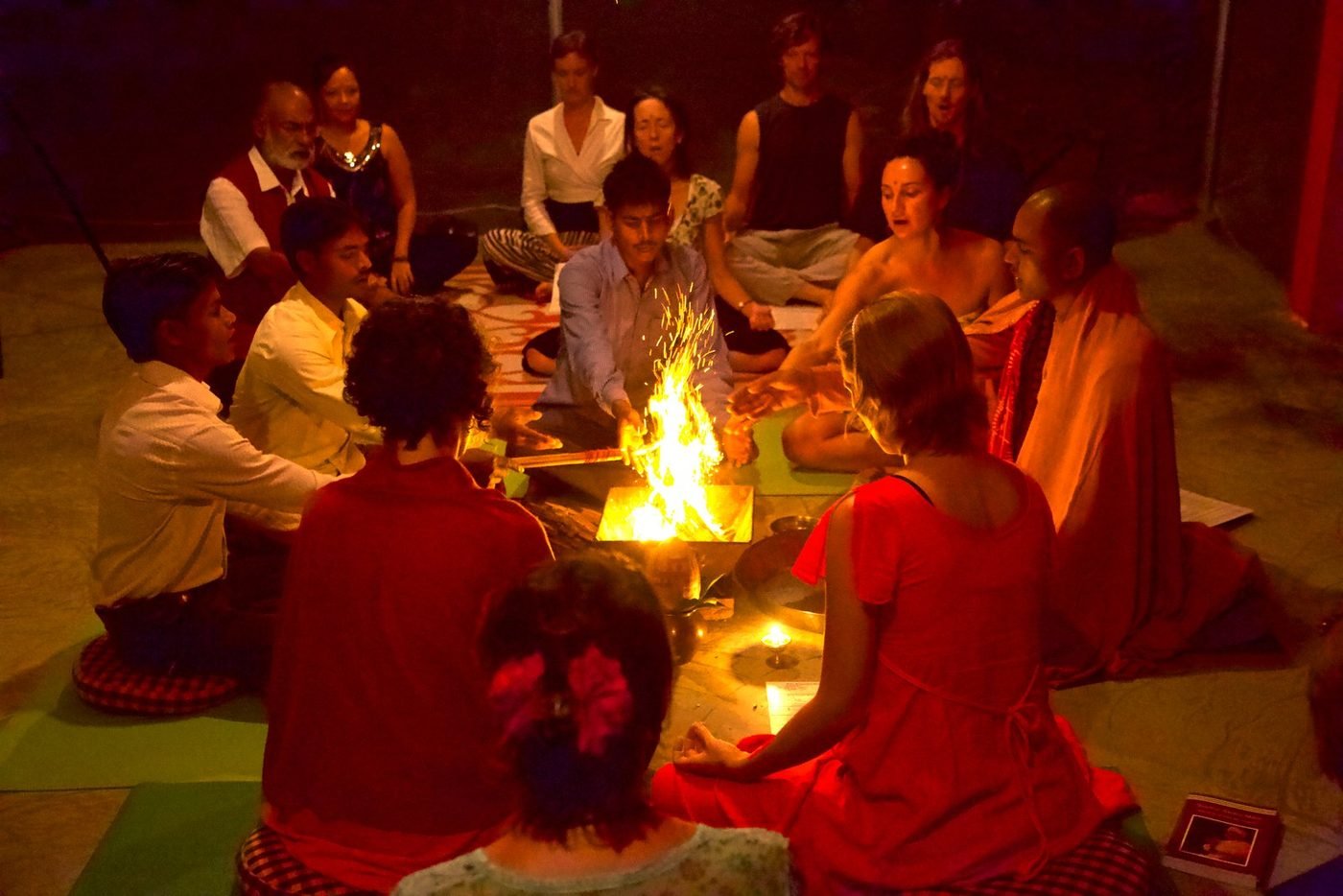 Philosophy
Bhakti Yoga is the path of devotion. At its heart is the movement from an ordinary relationship with the world towards a conscious relationship with the Divine. The word…
Read article Philosophy
If we look carefully at our experience, we discover something very interesting. We are aware of the body, but we are also aware of the fact that we have a body. We are aware…
Read articleEverything written here is taught in person, in sequence, at the ashram in Assagao.