Giving is very powerful. Give whatever you can, but you have to give. This is a universal principle, and whenever we interrupt that natural movement, there are consequences that we may not immediately recognise.
Look at nature. It is always giving. The sun gives light and warmth. Trees give oxygen, fruit, shade and shelter. Rivers give water. The earth gives food. Nature does not send us a bill for the oxygen we breathe, the sunshine we enjoy or the water that sustains us. Giving is part of the way life moves.
The Natural Movement of Giving
We receive constantly. From the moment we are born, we receive nourishment, care, knowledge, protection and countless things that we rarely stop to acknowledge. As we grow, we become accustomed to receiving, accumulating and holding on. Somewhere along the way, the natural movement can stop.
We receive, but do not always pass on what we have received. This breaks the continuity of the chain.
The principle is not complicated. What comes to us can also move through us. A person receives knowledge and passes it on. Another receives kindness and offers kindness to someone else. Someone receives an opportunity and creates an opportunity for another. We receive from the earth and have a responsibility towards the earth.
Giving does not always mean money. It can mean time, attention, knowledge, food, practical help, a kind word, a skill, or simply being present when someone needs us.
The Weakest Link
The chain of giving is working everywhere in nature. Why does it sometimes stop when it reaches us?
We receive from everywhere, yet human beings can become attached to possession and accumulation. We begin to think in terms of mine and yours, what we have gained and what we might lose. This is where the chain becomes weaker.
It is said that a chain is only as strong as its weakest link. In the great chain of life, we are both a small part and an important part. We are not separate from the process. What we do, how we live and what we give influences the world around us.
The ancient traditions of Yoga remind us that life is not meant to be lived entirely around the individual ego. Yoga gradually asks us to look beyond the narrow boundaries of I and mine and to recognise our relationship with something greater.
Giving and Yoga
Giving is closely connected with the yogic principle of seva, or selfless service. Seva does not mean that we become important because we serve others. In fact, the deeper practice is almost the opposite. We act without constantly asking, “What will I get in return?”
This does not mean neglecting ourselves or allowing others to take advantage of us. Giving in Yoga is not about becoming a martyr. It is about loosening the grip of self centredness.
When we practise giving without constantly calculating the return, something changes within us. The mind becomes less occupied with possession and more open to participation. This is one reason why Karma Yoga, the Yoga of action and selfless service, has such an important place in the Yoga tradition.
Action continues, but the attitude towards action changes.
Give Evolution a Chance
Paramahamsa Swami Satyananda Saraswati expressed this beautifully in the words:
“Give evolution a chance.”
There is something profound in this simple statement. We are already part of a process much larger than ourselves. Life is moving, changing and evolving around us all the time. The question is whether we cooperate with that movement or constantly resist it.
When we give, share, serve and participate, we allow ourselves to become part of the larger process rather than remaining concerned only with our own small circle.
This is not about trying to become a great spiritual person. It begins with ordinary things. Give a little time, share what you know, help someone who needs help, offer your skills, take care of the place where you live, give attention to someone who is speaking, cook for someone, teach someone, listen.
Sometimes the simplest acts of giving are the most meaningful.
The Leela of Life
In the Indian spiritual traditions, the universe is sometimes described as Leela, the cosmic play. If life is a Leela, then each of us has a part to play.
We do not choose every circumstance in which we find ourselves, but we can bring awareness to the way we participate. To be part of this Leela is to become more open, more receptive and more aligned with the movement of life.
This does not mean abandoning ordinary responsibilities. It means bringing a different understanding to them. Work becomes an opportunity for service. Knowledge becomes something to share. Food becomes something to offer. The natural world becomes something to care for. Relationships become opportunities to learn generosity, patience and understanding.
Even spiritual practice can become a form of giving when what we learn is allowed to benefit others.
Becoming More Receptive
Yoga asks us to become more aware. As the mind becomes quieter through practices such as asana, pranayama, meditation and Yoga Nidra, we begin to notice how much of our experience is shaped by habitual patterns of holding, resisting and identifying.
The more aware we become, the more easily we can recognise where we are holding on unnecessarily.
The image of a radio is useful here. A radio receives when it is properly tuned. In a similar way, the human mind can become more receptive when it is less disturbed by constant desire, fear and self centred thought.
The purpose of Yoga is not to make us superior to other forms of life. Rather, human birth is traditionally regarded as a valuable opportunity because of our capacity for awareness, reflection and conscious action.
That opportunity carries responsibility. If we have the capacity to understand, we also have the capacity to act with greater awareness.
Giving as a Spiritual Practice
Giving therefore becomes more than an act of generosity. It can become a spiritual practice.
Every time we give without demanding something in return, we have an opportunity to observe the mind. Why am I giving? Do I want recognition? Do I expect something back? Am I giving because I genuinely want to help? Can I give without making the other person feel indebted?
These questions can be more valuable than the act itself, because they turn giving into a form of self inquiry.
The real practice is not simply to give more. It is to understand how we give.
The Circle Comes Back
There is another beautiful aspect to giving. What we give often returns, although not necessarily in the form we expect. A person may teach someone something and never know how far that knowledge travels. A small act of kindness may influence someone who later extends that kindness to another person. A tree gives shade to someone who may never know who planted it. The circle continues.
Perhaps this is what makes giving so powerful. We do not always get to see where our contribution goes. We simply add our part to the chain and allow it to continue.
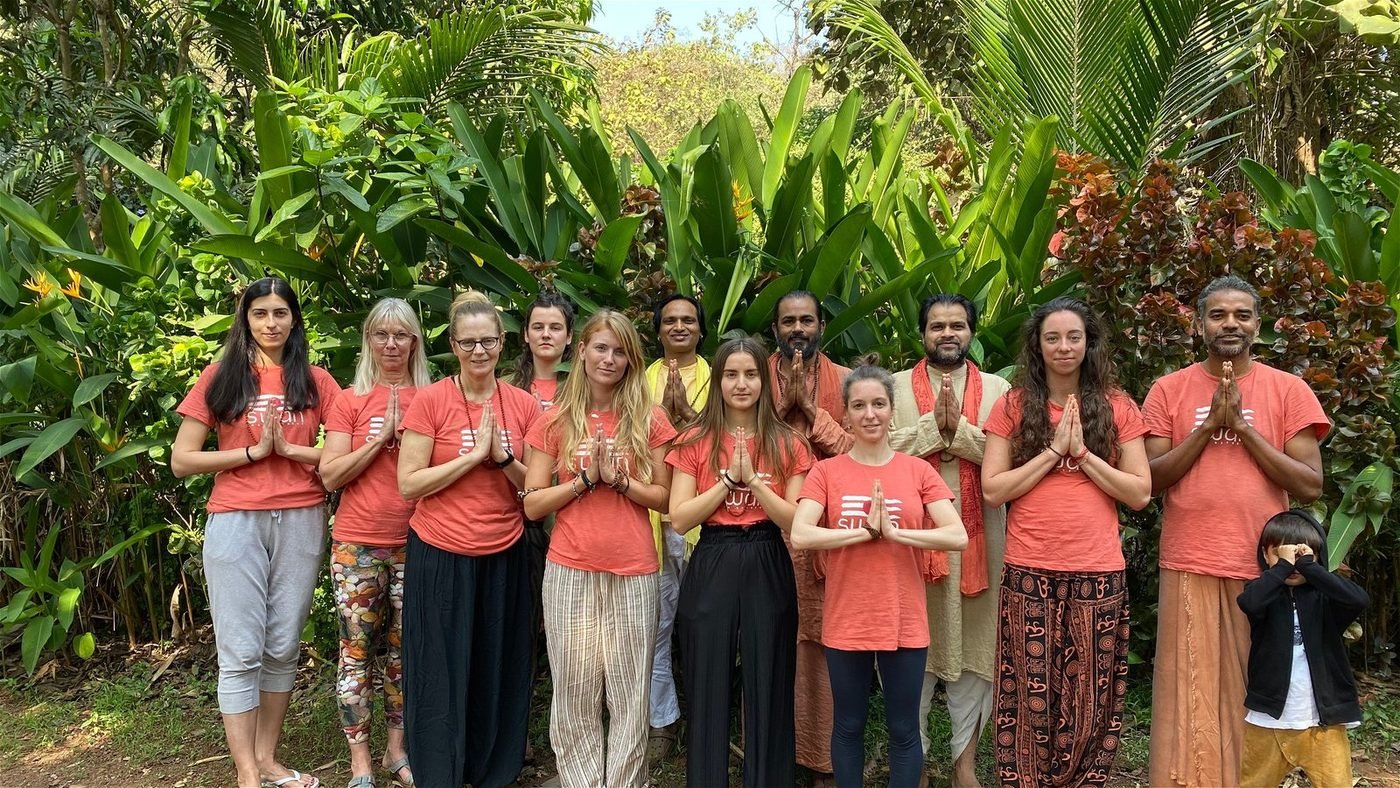
At SWAN, this understanding is part of the way we see Yoga. Practice is not meant to remain confined to the individual practitioner. What we receive from our teachers, our tradition, nature and the many people who make our own lives possible can, in some small way, be passed onwards.
A meal can be shared, knowledge can be taught, time can be offered, a skill can be used in service, and a practice can be shared with someone who needs it. The circle continues.
A Simple Question
Perhaps the most useful question is not: “What can I get?” but: “What can I give?”
Not everything has to be given away. We need rest. We need nourishment. We need healthy boundaries. We need to care for ourselves.
But within a life that receives so much, there must also be room for giving.
Nature has been showing us this from the beginning. It gives constantly. Perhaps Yoga is partly the process of remembering that we too are participants in this great movement of giving and receiving.
We receive, we learn, we grow, and then, in whatever way we can, we give something back.