
Part Two: Shiva, Shakti and the Art of Experience
If we look carefully at our experience, we discover something very interesting. We are aware of the body, but we are also aware of the fact that we have a body. We are aware…
Read article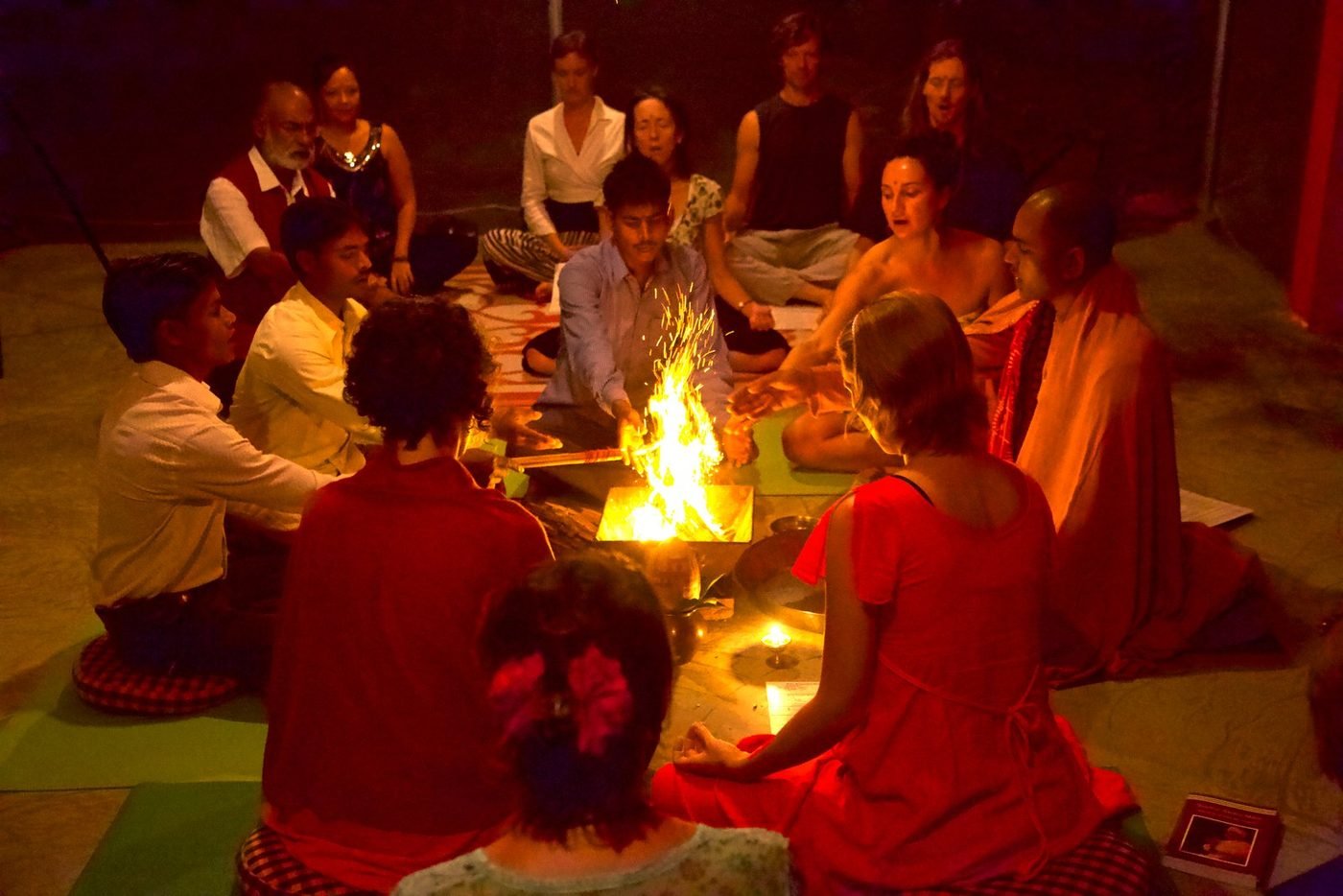
Bhakti Yoga is the path of devotion. At its heart is the movement from an ordinary relationship with the world towards a conscious relationship with the Divine. The word Bhakti comes from the Sanskrit root bhaj, associated with sharing, participation, devotion and worship. Bhakti is therefore much more than an emotional attachment to a particular form of God. It can become a profound spiritual discipline through which the heart, mind and actions are gradually directed towards the Divine.
Swami Sivananda described the transformative power of Bhakti in very direct terms, explaining that devotion can soften the heart and gradually weaken qualities such as jealousy, hatred, anger, pride and egoism while cultivating peace, joy and knowledge. In this understanding, devotion is not an escape from life or merely an emotional experience. It is a method of inner purification.
The Bhakti tradition describes many ways in which this relationship with the Divine can be cultivated. One of the best known teachings is Navadha Bhakti, the nine forms of devotion. These nine forms are described in the Srimad Bhagavatam and provide a beautiful framework through which the practice of devotion can be understood.
The nine forms are not necessarily nine stages that every practitioner must complete one after another. A person may naturally be drawn towards one form, while another may find several forms developing together. What matters is the sincerity with which devotion is practised.
Shravana means hearing or listening. In Bhakti Yoga, it refers particularly to listening to the stories, teachings and qualities of the Divine through sacred texts and through the words of sincere practitioners and teachers.
Listening may appear passive, but it can become a powerful spiritual practice when undertaken with attention. The mind is constantly being shaped by what it hears. Ordinary conversation, entertainment, news and the constant flow of information around us all leave impressions upon the mind. Shravana offers the possibility of consciously exposing the mind to teachings that direct attention towards spiritual values.
A traditional example is Maharaja Parikshit, who spent the final seven days of his life listening to the Srimad Bhagavatam from Shukadeva Goswami. The story illustrates the power of attentive listening when the mind is completely turned towards the search for truth.
For a student of Yoga, listening to teachings is an important part of Sadhana. The study of the Bhagavad Gita, Yoga Sutras, Upanishads and other traditional texts becomes much more meaningful when it is combined with practice, contemplation and reflection.
Kirtan is the expression of devotion through singing, chanting and recitation. It is often practised collectively, sometimes in a call and response format, although devotional chanting can also be practised individually.
Sound has an important place in many traditions of Yoga. Mantra and Kirtan can help gather the scattered attention of the mind and direct it towards a chosen spiritual focus. When practised with sincerity, the repetition of a Divine name is not merely a musical activity. It can become a form of concentration, remembrance and devotion.
The tradition of Bhakti places great importance on hearing and repeating the names and qualities of the Divine. Through Kirtan, the mind is given an opportunity to move away from its habitual preoccupation with worldly concerns and become absorbed in a devotional mood.
Kirtan also has a natural place within a residential Yoga environment. After Hatha Yoga, Pranayama and meditation, devotional chanting can create a different quality of participation and openness. It brings people together through sound and allows devotion to be experienced collectively rather than only as a private practice.
Smarana means remembrance. In Bhakti Yoga, it refers to remembering the Divine through contemplation of the Divine name, qualities, form or presence.
The mind naturally remembers what it considers important. We remember people we love, things we fear, experiences that have affected us and events to which we are emotionally attached. Smarana applies this natural capacity for remembrance to spiritual life.
The devotee repeatedly brings awareness back towards the Divine rather than allowing the mind to become completely absorbed in its habitual patterns.
Prahlada Maharaja is traditionally given as an example of this form of devotion. Despite the difficult circumstances described in the Srimad Bhagavatam, his remembrance of Vishnu remained unwavering.
For a contemporary practitioner, Smarana does not necessarily mean thinking about God every moment of the day. It can begin with regular Mantra, prayer or meditation and gradually extend into ordinary life. The important point is to develop a relationship with remembrance so that spiritual awareness does not remain confined to formal practice.
Pada Sevanam literally refers to serving the feet of the Divine. Within the devotional tradition, the feet of the deity or Guru symbolise humility, reverence and surrender.
Lakshmi, the Goddess of prosperity and consort of Vishnu, is traditionally depicted serving the feet of the Lord. The image represents loving service without the demand for personal recognition.
Pada Sevanam also connects naturally with the principle of Seva and Karma Yoga. When service is performed as an offering rather than as a means of gaining status or reward, ordinary activity can become a spiritual practice.
This does not require elaborate ritual. Caring for another person, maintaining a place of practice, preparing food or helping within a Yoga community can all become expressions of Seva when performed with awareness and devotion.
The important transformation takes place within the person performing the action. The same activity can be performed for personal recognition or as an offering. Bhakti asks us to discover the difference.
Archana means worship or offering. It is traditionally associated with the ritual worship of a chosen form of the Divine and may include Puja, Mantra, flowers, incense and other offerings.
Havan or Homa, the traditional fire offering, is another important ritual found within many Indian spiritual traditions, although it has its own distinct form and significance.
The deeper principle behind Archana is the act of offering. Something that we normally regard as belonging to us is consciously offered to something greater than ourselves.
Maharaja Prithu is traditionally described as an exemplary devotee who used his position and resources in the service of the Divine.
Archana therefore invites us to examine our relationship with possession. What do we consider to be ours? What are we willing to offer? Can we make an offering without constantly calculating what we will receive in return?
The external ritual can be simple or elaborate, but its spiritual value depends largely upon the attitude with which it is performed.
Vandana means prayer, praise or reverential salutation. It is the practice of turning towards the Divine through prayer and expressing humility, gratitude, devotion or a request for guidance.
Prayer is sometimes understood only as asking God for something. Within Bhakti Yoga, however, prayer can take many forms. It can be an expression of gratitude, an acknowledgement of our limitations, an offering of our difficulties or simply an opening of the heart towards the Divine.
Akrura, who was sent to bring Krishna from Vrindavana, is traditionally described as offering prayers to Krishna during his journey.
The deeper value of prayer lies not only in the words themselves but in the attitude behind them. A sincere prayer can soften the rigidity of the ego and remind us that we are not entirely self sufficient.
For many practitioners, prayer also provides a bridge between formal Yoga practice and ordinary life. A moment of gratitude or remembrance can transform an otherwise ordinary activity into an expression of devotion.
Dasya means servitude or the attitude of being a servant of the Divine. It represents a willingness to place the Divine will above the demands of personal ego.
Hanuman is perhaps the most celebrated example of Dasya Bhakti. His relationship with Rama is characterised by complete dedication and service. His strength, intelligence and abilities are not presented as possessions for his own glory. They are placed entirely at the service of Rama.
This is an important distinction because Dasya does not mean becoming weak or passive. Hanuman is one of the strongest and most courageous figures in the Ramayana. His humility exists alongside extraordinary strength and capability.
For a modern practitioner, the principle can be understood as asking whether our abilities are being used only for personal gain or whether they can also serve something larger than ourselves.
This brings Bhakti into a natural relationship with Karma Yoga. Action becomes an offering when the individual is less concerned with personal recognition and more concerned with performing the action sincerely.
Sakhya means friendship. Here the relationship between the devotee and the Divine is not primarily one of fear or distance but of intimacy and trust.
Arjuna's relationship with Krishna is one of the most important examples. Krishna is his friend, guide and spiritual teacher, and the intimacy between them forms the foundation of the Bhagavad Gita.
The beauty of Sakhya Bhakti lies in the possibility that spirituality does not always have to be experienced through solemnity. A genuine relationship with the Divine can include love, trust, conversation and intimacy.
The Divine is not merely a distant authority who must always be approached with fear. Within the Bhakti tradition, the relationship can become deeply personal.
This is one reason devotional Yoga has such a wide emotional range. It can express reverence, surrender, friendship, love, longing and gratitude. Different practitioners may naturally experience the Divine through different forms of relationship.
The ninth form is Atma Nivedana, complete self offering or surrender of oneself to the Divine.
This is perhaps the deepest expression of Bhakti because the offering is no longer limited to possessions, actions or words. The devotee offers the sense of personal ownership itself.
The traditional example is Bali Maharaja, who is described in the Srimad Bhagavatam as offering everything to Vamana, an incarnation of Vishnu. He ultimately offers himself, despite opposition from his spiritual preceptor Shukracharya.
Atma Nivedana should not be misunderstood as passive submission or the abandonment of personal responsibility. Spiritual surrender is not an excuse for refusing to think, discriminate or act. Rather, it represents a profound loosening of the ego's insistence that everything must happen according to personal desire.
This is closely related to the principle of Ishvara Pranidhana, the offering or surrender of one's actions and being to Ishvara, which Patanjali identifies as an important element of Yoga practice.
The nine forms of Navadha Bhakti offer different doorways into the same fundamental movement. We listen, sing, remember, serve, worship, pray, dedicate ourselves, develop a relationship of friendship and ultimately offer ourselves to the Divine.
These practices do not have to remain separate from the other paths of Yoga.
A person practising Hatha Yoga may use Mantra and prayer. A student of meditation may discover devotion. Someone engaged in Karma Yoga may gradually experience Seva as an offering. A student undertaking a Yoga Teacher Training Course may encounter Bhakti Yoga through the study of the Bhagavad Gita, Mantra, Kirtan and traditional spiritual practices.
This is one of the strengths of the traditional approach to Yoga. The different paths are not necessarily competing systems. They can support and deepen one another.
Bhakti also reminds us that spiritual practice is not only an intellectual pursuit. We can understand philosophy very well and still remain emotionally closed. We can perform asana with great discipline and still remain caught in pride. We can meditate regularly and still carry resentment.
Devotion introduces another dimension.
It asks us to soften and to recognise that spiritual life is not only about controlling the mind or acquiring knowledge. It is also about developing humility, gratitude, love and the willingness to offer ourselves to something greater than our individual identity.
This is why Bhakti Yoga has remained such a powerful tradition within Indian spiritual life. Whether expressed through meditation, Mantra, Kirtan, Puja, Havan, prayer or simple acts of service, devotion can gradually transform the way we relate to ourselves, to other people and to the Divine.
The nine forms of devotion are therefore not merely a collection of religious practices. They are nine ways of opening the heart and bringing awareness into our relationship with the sacred.
Article by SWAN Yoga.
Copyright SWAN Yoga Retreat, Assagao, Goa, India.
 Philosophy
If we look carefully at our experience, we discover something very interesting. We are aware of the body, but we are also aware of the fact that we have a body. We are aware…
Read article Philosophy
There is a well known story about six blind men who went to see an elephant. Each man touched a different part of the animal and came to a different conclusion about what an…
Read article Philosophy
Samadhi is attained through Ishvara Pranidhana.
Read articleEverything written here is taught in person, in sequence, at the ashram in Assagao.