
Eat Pray Love: Living in a Yoga Ashram in India
The book Eat Pray Love, followed by the popular film, introduced millions of people to the idea of travelling to India in search of something deeper than an ordinary holiday.
Read article
On June 21, the International Day of Yoga is celebrated across the world. For those who practise Yoga, teach Yoga or have an interest in understanding its deeper traditions, the day provides an opportunity not only to celebrate Yoga but also to reflect on what Yoga actually means. Yoga has travelled far beyond India and is now practised in many different forms and for many different purposes, yet its roots remain deeply connected with the spiritual, philosophical and contemplative traditions of India. In many ways, Yoga can be regarded as one of India's profound contributions to humanity, particularly as a way of exploring a more conscious, harmonious and meaningful relationship with ourselves, with others and with the world around us.
If we want to understand the purpose of Yoga, however, we have to look beyond its modern presentation and return to the sources, teachings and traditions through which it has been transmitted. Yoga is not simply a collection of physical exercises that has developed in recent times. It is a vast body of knowledge that has evolved through different traditions, teachers, texts and lineages over many centuries. The word Yoga itself carries a depth of meaning, and the tradition cannot be fully understood without considering its philosophical foundations and the many methods through which practitioners have explored the nature of consciousness.
Within the Indian spiritual traditions, Yoga is often regarded as timeless, and its roots are found throughout Vedic and post Vedic literature. Different traditions preserve different accounts of its origins and emphasise different teachers and sources. In the Shaiva and Nath traditions, Shiva is revered as Adinath, the primordial teacher of Yoga and the archetype of the supreme Yogi. Within these traditions, he is regarded as the first Guru from whom the teachings were transmitted.
Sage Kapila is traditionally associated with the Samkhya tradition, one of the major philosophical systems of India. Samkhya provides an important framework for understanding the distinction between consciousness and the material world and examines the causes of human experience and suffering. Its philosophical influence can be found throughout the development of Yoga, particularly in the way Yoga discusses Purusha, Prakriti, the Gunas and the process through which consciousness becomes identified with the changing aspects of nature.
Sage Patanjali occupies another important place in the history of Yoga. The Yoga Sutras attributed to Patanjali systematise a body of teachings concerned with the discipline and refinement of the mind and with the attainment of Samadhi. Patanjali presents Yoga as a systematic means of understanding the movements of the mind, overcoming the causes of suffering and ultimately attaining a state of deeper freedom and clarity.
The eight limbs of Patanjali's Ashtanga Yoga are Yama, Niyama, Asana, Pranayama, Pratyahara, Dharana, Dhyana and Samadhi. These encompass ethical discipline, personal discipline, physical steadiness, regulation of the breath, withdrawal of the senses, concentration, meditation and deeper states of consciousness. They should not necessarily be understood as eight rigid steps through which every practitioner must move in exactly the same order. Rather, they are interconnected dimensions of Yoga practice that support the gradual refinement of the individual.
Hatha Yoga developed through several traditions, including the Nath tradition, and was expressed through important medieval texts such as the Hatha Yoga Pradipika, Gheranda Samhita and Shiva Samhita. The Hatha Yoga found in these texts is considerably broader than the physical Yoga practice that is commonly presented under the name Hatha Yoga today.
Traditional Hatha Yoga includes practices such as Shatkarma, Asana, Pranayama, Mudra and Bandha, each of which has a particular place within the wider discipline. The practices work progressively with the body, breath, senses and subtle aspects of the practitioner, preparing the individual for greater steadiness and awareness. Shatkarma includes traditional cleansing practices, Asana develops stability and physical awareness, Pranayama works with the breath and Prana, while Mudra and Bandha are used within the traditional understanding of the subtle body and the regulation of vital energy.
Hatha Yoga also has deep historical and philosophical connections with Tantric traditions. Concepts such as Chakras, Kundalini, Prana and the subtle body appear in both Yogic and Tantric contexts, although Hatha Yoga and Tantra should not simply be treated as identical systems. They developed through different textual and lineage traditions, even though there is considerable overlap between them. Within many traditional presentations, Hatha Yoga is understood as a means of preparing the practitioner for deeper meditation and the states associated with Raja Yoga.
This is an important distinction because the physical postures represent only one part of Hatha Yoga. When Asana is separated completely from Pranayama, Mudra, Bandha, meditation and the philosophical understanding behind the practices, much of the original purpose of Hatha Yoga is lost.
Yoga also cannot be reduced to a single method or practice. The Bhagavad Gita presents a broad vision of Yoga in which spiritual practice can be approached through different temperaments and circumstances. Karma Yoga, Jnana Yoga, Bhakti Yoga and Dhyana or Raja Yoga are among the best known approaches described within the wider tradition.
Karma Yoga is concerned with action and with learning how to perform our responsibilities without becoming bound by attachment to their results. Jnana Yoga approaches liberation through knowledge, enquiry and discrimination, asking us to examine what is permanent and what is changing and to investigate the nature of the Self. Bhakti Yoga develops devotion, surrender and love towards the Divine, while Dhyana Yoga emphasises meditation and the cultivation of a steady and concentrated mind.
These paths should not necessarily be regarded as competing systems. In a complete spiritual life they can complement one another, because action, knowledge, devotion and meditation are not separate aspects of human existence. One may naturally become more inclined towards one approach, while still benefiting from the others.
The Bhagavad Gita is particularly significant because it brings spiritual life directly into the circumstances of ordinary existence. Sri Krishna does not tell Arjuna that he must abandon the world in order to pursue Yoga. Instead, he teaches him how action, knowledge, devotion and meditation can become part of the way he lives and fulfils his responsibilities. This is one of the reasons the Bhagavad Gita continues to have such relevance for people living in the modern world.
Yoga is much more than physical exercise. It can be understood as a spiritual discipline, a philosophical system and a way of living that encourages greater awareness of the relationship between our body, breath, mind, actions and deeper nature. Although the practices of Yoga can support physical and mental wellbeing, these benefits do not represent the complete purpose of the tradition.
The deeper teachings of Yoga ask us to examine the nature of human experience itself. Why do we suffer? Why do we become attached to things that are constantly changing? Why does the mind repeatedly fall into the same patterns of desire, fear, expectation and identification? Can we develop sufficient awareness to see these patterns clearly rather than continually being driven by them?
Patanjali's Yoga Sutras approach these questions through a systematic exploration of the mind and the causes of suffering. The purpose of Yoga, from this perspective, is not simply to make life more comfortable but ultimately to move towards freedom from the ignorance and identification that create suffering. Physical health, emotional balance and mental steadiness can therefore be valuable aspects of the journey, but the traditional goal of Yoga extends towards liberation.
The idea of being a beginner in Yoga is not necessarily determined by how many years someone has spent attending Yoga classes. A person may have practised Asana for ten or twenty years and still have had little opportunity to study the philosophical foundations of Yoga, while someone who has recently begun studying the Yoga Sutras or Bhagavad Gita may already be developing an understanding of dimensions of Yoga that are not usually encountered in a physical class.
Traditional Yoga encompasses a vast field of knowledge that includes philosophy, ethics, meditation, Pranayama, Asana, Mantra, Mudra, Bandha and many other practices. Someone who practises only one aspect of this tradition, regardless of how long they have been practising it, still has much more to discover.
This is why humility is so important in Yoga. There is always something more to learn, and there is a considerable difference between collecting information about Yoga and allowing its teachings to become part of one's understanding and experience.
Yoga has travelled throughout the world and has naturally taken many different forms. Some contemporary approaches focus primarily on physical practice, while others include meditation, Pranayama, philosophy and traditional practices. There is nothing inherently wrong with adaptation, and Yoga has always existed through living traditions that have responded to different cultures and circumstances.
At SWAN, however, our emphasis is on understanding Yoga through its traditional sources and lineages. We believe that a practitioner who wishes to understand Yoga more completely should have the opportunity to study not only Asana but also the philosophical and spiritual teachings that give the practices their context and meaning.
Traditional Yoga includes the body, but it does not end with the body. Asana and Pranayama are important parts of the practice, but they exist within a much broader tradition that includes meditation, ethical discipline, self observation, Mantra, Mudra, Bandha, Karma Yoga, Bhakti Yoga, Jnana Yoga and the deeper exploration of consciousness.
For this reason, we believe that learning Yoga should involve more than learning how to perform postures correctly. It should also involve an exploration of why the practices are performed, where they come from, what they are intended to develop and how they can become part of a broader way of living.
The International Day of Yoga gives us an opportunity to celebrate the growing recognition of Yoga throughout the world, but it can also invite us to look more deeply into the tradition itself. Yoga can begin with the body, but through practice it can lead us towards an examination of the breath, the senses, the mind, our patterns of behaviour and eventually our understanding of who we are.
When we practise Asana, can we develop greater awareness rather than simply greater flexibility? When we practise Pranayama, can we become more conscious of the relationship between breath, energy and mind? When we meditate, can we learn to observe the movements of the mind without automatically following every thought? And when we study the Yoga Sutras or Bhagavad Gita, can their teachings influence the way we approach action, attachment, responsibility and relationships in everyday life?
These questions take us beyond Asana and towards Yoga as a complete tradition.
At SWAN, we welcome those who wish to learn, understand, practise and live traditional Yoga with respect for its classical texts, teachings and lineages. Whether someone comes to Yoga through Asana, meditation, Pranayama, philosophy or a simple curiosity about the deeper traditions of India, there is always an opportunity to explore further.
Perhaps this is the most meaningful way to celebrate the International Day of Yoga: not simply by practising Yoga for one day, but by becoming curious about what Yoga has been pointing towards for generations of practitioners.
May we all become healthier, wiser, loving and peaceful.
Article by SWAN Yoga.
Copyright SWAN Yoga Retreat, Assagao, Goa, India.
 Ashram Life
The book Eat Pray Love, followed by the popular film, introduced millions of people to the idea of travelling to India in search of something deeper than an ordinary holiday.
Read article Ashram Life
The Traveller wrote to us one day with faith, trust and lots of ideas in his mind. We greeted him and wrote back:
Read article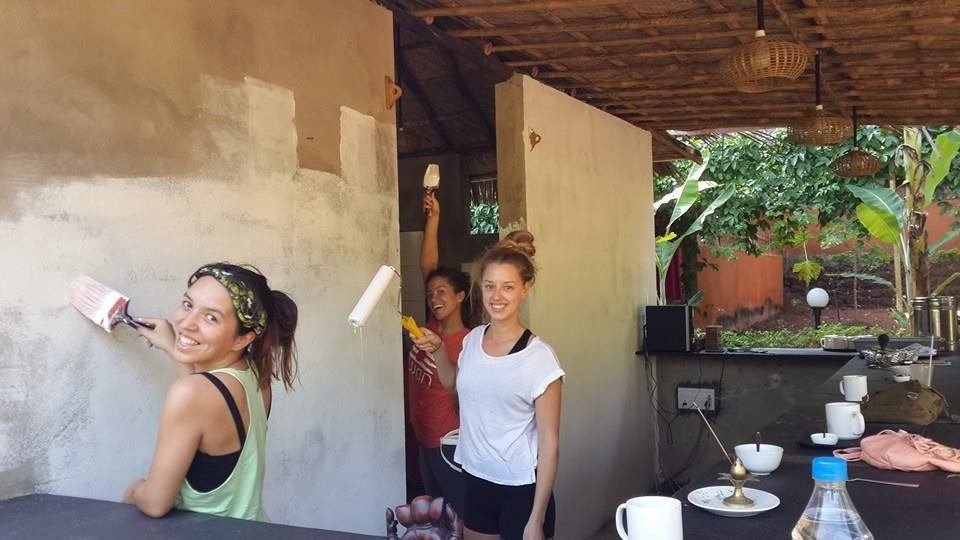 Ashram Life
The word Ashram can bring different images to mind. For some people, it means a place where spiritual seekers live with a Guru. For others, it may suggest meditation, simple…
Read articleEverything written here is taught in person, in sequence, at the ashram in Assagao.