
Eat Pray Love: Living in a Yoga Ashram in India
The book Eat Pray Love, followed by the popular film, introduced millions of people to the idea of travelling to India in search of something deeper than an ordinary holiday.
Read article
Today, followers of Sanatana Dharma celebrate one of the most auspicious occasions in the Hindu calendar: Rama Navami, the day commemorating the birth of Bhagwan Shri Rama.
According to the Hindu Panchangam, Rama Navami falls on the ninth day, Navami, of the bright half of the month of Chaitra. Chaitra is traditionally regarded as the first month of the Hindu lunar calendar, and Rama Navami also falls during the period of Chaitra Navaratri. The day therefore brings together two important celebrations: the birth of Shri Rama and the worship of the Divine Mother in her various manifestations of Shakti.
So, what is Rama Navami, and why is the birth of Shri Rama considered so significant?
In the Vaishnava tradition, Shri Rama is understood as an avatar of Bhagwan Vishnu, who descended into the world to uphold Dharma and restore balance. Rama is not remembered only as a divine figure, however. He is also revered as an ideal human being whose life represents Dharma, truthfulness, courage, compassion, responsibility, loyalty and the ability to uphold what is right even when circumstances are difficult.
This is why Shri Rama is known as Maryada Purushottama, often understood as the supreme person who lives within and upholds the boundaries of Dharma. His story is not simply about a divine incarnation living in another age. The Ramayana also presents a profound exploration of human relationships, responsibility, sacrifice, love, loyalty and the difficult choices that arise when different duties come into conflict.
Rama Navami also falls during Navaratri, which literally means “nine nights”. During Chaitra Navaratri, the Divine Mother is worshipped through different manifestations of Shakti. To understand the significance of Shakti, it is useful to look briefly towards the Tantric traditions of India.
Tantra is a vast and diverse body of spiritual traditions, and it cannot be reduced to a single definition. At its heart, however, many Tantric traditions explore the relationship between consciousness and energy, often symbolised through Shiva and Shakti.
Shiva represents pure consciousness, while Shakti represents the dynamic power through which consciousness manifests as the universe and all experience within it. Shakti is therefore not simply an external goddess or force separate from consciousness. In many Tantric traditions, she represents the creative and manifesting power of consciousness itself.
Shakti is sometimes described as the universal womb, the source through which creation comes into manifestation. The relationship between Shiva and Shakti is therefore one of profound philosophical significance. They are not two completely separate realities, but two inseparable aspects of existence: consciousness and its power of manifestation.
Tantra explores this relationship through many different practices and philosophical approaches, with liberation as a central concern. The union of Shiva and Shakti can therefore be understood not simply as an external event but as an inner recognition of the inseparability of consciousness and its dynamic power.
So what happens when Shiva and Shakti unite?
From the perspective of spiritual practice, this question can also be understood within ourselves. What happens when awareness and energy are no longer experienced as separate? What happens when the scattered movements of the mind become quiet and we begin to recognise a deeper dimension of our own being?
The traditional teachings describe liberation in different ways, but they repeatedly point towards freedom from Avidya, ignorance of our true nature, and from the patterns of attachment, aversion and desire that keep us bound to suffering. The Kleshas described by Patanjali include Avidya, Asmita, Raga, Dvesha and Abhinivesha, and the spiritual traditions of India offer many different approaches for understanding and overcoming these limitations.
Perhaps this gives us another way of looking at Shri Rama.
Rama represents a human being who is deeply established in Dharma. He is associated with truth, strength, compassion, kindness, courage, forgiveness, friendship, responsibility and justice. His greatness is not simply that he is regarded as divine, but that his life provides an enduring example of how Dharma can be lived even when circumstances are difficult.
In this sense, Rama can also become an inner ideal.
There is Rama in all of us as a possibility: the possibility of living with greater clarity, integrity, compassion and awareness. The story of Rama can therefore be approached not only as sacred history or mythology, but also as a teaching about the qualities that we can cultivate within ourselves.
When we celebrate Rama Navami, we can therefore celebrate more than the birth of a divine incarnation. We can also reflect on the birth of Dharma within our own lives. We can ask ourselves whether our thoughts, words and actions are moving us towards greater truthfulness, compassion and responsibility, or whether we are still being governed by ignorance, attachment, anger and uncontrolled desire.
This is where spiritual traditions become relevant to everyday life. The purpose of Yoga and spiritual practice is not simply to collect philosophical knowledge or perform rituals. The deeper purpose is to transform our relationship with ourselves and with the world through greater awareness.
On this Rama Navami, let us remember Bhagwan Shri Rama as Maryada Purushottama, the embodiment of Dharma and an enduring symbol of truth, courage, compassion and integrity.
Let us also remember that the qualities we honour in Rama are not merely qualities to admire from a distance. They are qualities that we can strive to cultivate within ourselves.
May Shri Rama bless us with the wisdom to recognise Dharma, the courage to follow it, and the clarity to overcome the ignorance that keeps us from seeing our true nature.
May there be light, peace and joy within all of us.
Hari Om Tat Sat 🙏
⭐️❤️
Article by SWAN Yoga.
Copyright SWAN Yoga Retreat, Assagao, Goa, India.
 Ashram Life
The book Eat Pray Love, followed by the popular film, introduced millions of people to the idea of travelling to India in search of something deeper than an ordinary holiday.
Read article Ashram Life
The Traveller wrote to us one day with faith, trust and lots of ideas in his mind. We greeted him and wrote back:
Read article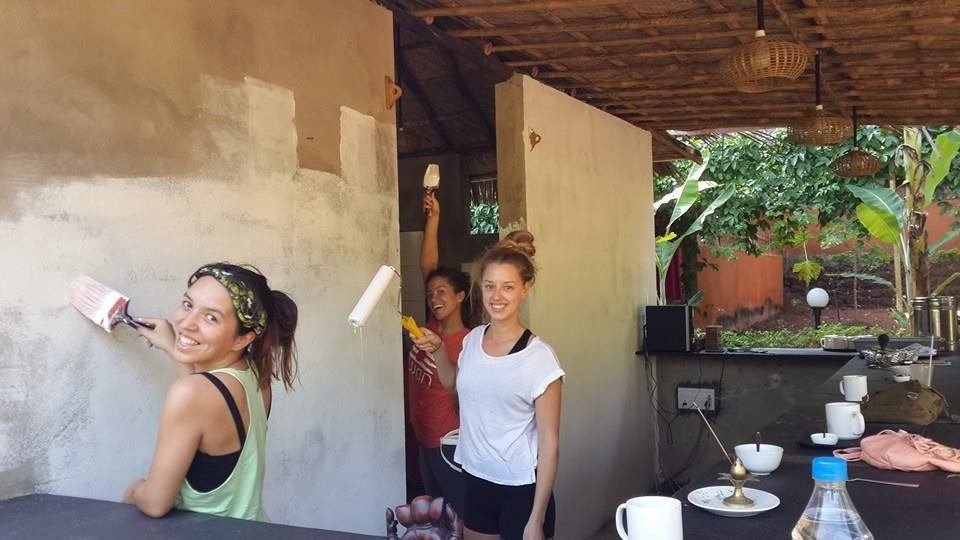 Ashram Life
The word Ashram can bring different images to mind. For some people, it means a place where spiritual seekers live with a Guru. For others, it may suggest meditation, simple…
Read articleEverything written here is taught in person, in sequence, at the ashram in Assagao.